| Dear Readers,
sustainability does not end with ecological goals – it reaches deep into social and economic processes. However, when objectives are in conflict, tensions arise: Improved occupational safety may increase emissions, green financial instruments fall flat without intelligent design, and more social justice can lead to higher demand for land in the short term
The new issue of ZEW Monthly, “Thinking Ecology”, shows why genuine transformation can only succeed if ecological consequences are taken into account from the very beginning.
We hope you enjoy your reading.
|
|
|
|
| |
 | | | RESEARCH ON THINKING ECOLOGY |
| |
| |
|
| | | |
↗ GREEN BONDS AS A CATALYST FOR THE GREEN TRANSFORMATION?
|
| Green bonds are intended to channel capital into sustainable projects – but do they actually deliver on this promise? A new ZEW policy brief shows: when governments issue green bonds, they can use auction design to steer institutional investors towards a more sustainable orientation. “Green bonds certainly have the potential to generate positive environmental effects. For example, by encouraging institutional investors to increase their investments in green financial products or by motivating banks to provide loans with a positive climate impact,” says ZEW economist Karolin Kirschenmann.
|
| More about the study
|
| |
| |
|
|
|
| | | | |
↗ HEALTH AND SAFETY AT WORK TAKES PRECEDENCE OVER SUSTAINABILITY
|
| Unionised facilities attach a higher priority to worker health and safety than non-unionised facilities. This leads to higher toxic waste emissions and a decline in waste treatment such as recycling and energy recovery. Prevention measures are insufficient to fully offset the increase in emissions. These are the findings of a recent ZEW study on the impact of union elections on hazardous waste management in the US. “Our study illustrates how in bargaining negotiations trade unions frequently have to accept compromises on environmental aspects,” explains ZEW researcher Eline Schoonjans.
|
| More about the study
|
| |
| |
|
|
|
| | | | |
↗ SOCIAL JUSTICE CAUSES SHORT-TERM INCREASE IN LAND USE
|
| The initial effect of less income inequality is a higher biodiversity footprint, in particular driven by the land use implications of a change in consumption. This is mainly due to increased meat consumption, as shown by a new ZEW study. “This shows that environmental and distributional objectives do not automatically align. To achieve national and global biodiversity goals, additional conservation measures are needed, if income inequality is reduced at the same time,” ZEW economist Tim Kalmey concludes.
|
| More about the study
|
| |
| |
|
|
|
|
|---|
| |
 |
|
| | |
| | ↗ FEW COMPANIES ARE PLANNING TO SEND EMPLOYEES BACK TO THE OFFICE
|
| Only a small number of companies want to move away from working from home (WFH) by reducing or even completely discontinuing their remote work models over the next two years. However, firms are critical of some aspects of working from home, according to the findings of a representative ZEW survey with around 1,200 companies in June 2025.
|
|
| |
|
| |
|
|
|
|
|
| | |
|
| | | |
↗ CHRISTINA JANIK TAKES OVER AS HEAD OF HUMAN RESOURCES AT ZEW
|
| On 1 October 2025, Christina Janik took over as head of Human Resources at ZEW – Leibniz Centre for European Economic Research in Mannheim. In her new role, she is responsible for the strategic planning, development and management of all personnel matters within the organisation. Her tasks also include the continued development of the Human Resources Service Unit. Christina Janik brings with her many years of experience in human resources. After completing her studies at the University of Mannheim, she held various HR positions including at Deutsche Bahn, where she worked for nine years, seven of which were in a management position.
|
| More about the topic
|
| |
| |
|
|
|
| | | | |
↗ ZEW MANNHEIM TO DEVELOP RESEARCH ON HEALTH CARE MARKETS IN THE DIGITAL AGE
|
| The ZEW is expanding its research spectrum. The committee of the Joint Science Conference (GWK) of the federal government and federal states cleared the way for the ZEW application for what is referred to as an extraordinary item of expenditure – in this case, a research programme focusing on the implications of the digital transformation for the analysis and the design of digital health care markets. This paves the way for an expansion of the Institute's activities by establishing an independent health economics research unit. A project group headed by ZEW economist Simon Reif has already prepared the ground.
|
| More about the topic
|
| |
| |
|
|
|
| | | | |
↗ MARION OTT TAKES UP MARKET DESIGN PROFESSORSHIP IN GIESSEN
|
| As of 1 August 2025, ZEW economist Marion Ott has assumed the Chair of Market Design at Justus Liebig University Giessen (JLU). She will carry out this new role in parallel with her position as deputy head of ZEW’s Research Unit “Market Design“. Her research focuses on the design and analysis of markets, with particular emphasis on auctions and on advancing the future design of electricity markets. “I’m keen to incorporate my research topics from ZEW into my teaching in Giessen and to inspire young people to take an interest in market design and the organisation of auctions.”
|
| More about the topic
|
| |
| |
|
|
|
|
|---|
| |
|
|
| | |
Happy faces and a full house in Hamburg: On a sunny day, the best school teams from all over Germany came together at Bucerius Law School from 23 to 25 September 2025 for the national final of the YES! high school competition to compete against each other with innovative ideas for how to solve pressing future issues. The two teams supported by ZEW emerged victorious, defeating ten other school teams.
|
| More about the YES!-Final
|
|
| |
|
| |
| | |
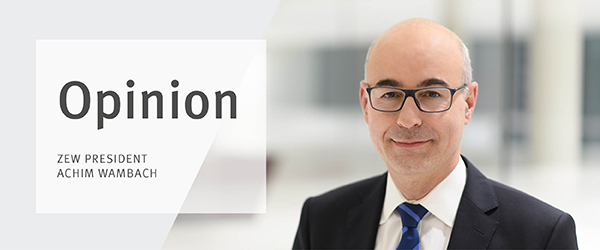
Donald Trump despises climate policy. With the world's largest economy no longer participating, what is the point of Europe engaging in climate action and damaging its economy in the process? ZEW President Achim Wambach explores this question in a guest article for DIE ZEIT.
|
| Read the full opinion piece
|
|
| |
|
| |
|
|
|
| | |
| | REVIEW
|
| ↗ FIRST-HAND INFORMATION ON ECONOMIC POLICY
Nobel Laureate Sheds Light on Market Mechanisms in Online Advertising
In the digital advertising market, complex auctions determine the interactions between market players. In addition to high bidder numbers, short-term transactions and a broadly diversified media market, the bundling of bids on advertising platforms and provider behaviour across platforms increase this complexity. Paul Milgrom, laureate of the Nobel Prize in Economics, explained the effects of this and the role market design plays in this context during a talk at a “First-Hand Information on Economic Policy” event organised by ZEW on 8 October 2025.
|
|
| |
|
| |
|
| | ↗ CONFERENCE
International Researchers Discuss Current Findings on Entrepreneurial Dynamics and Innovations by Start-Ups
On 9 and 10 October 2025, the ZEW Research Unit “Economics of Innovation and Industrial Dynamics” hosted the sixth “Conference on the Dynamics of Entrepreneurship (CoDE)”. Three international keynote speakers from Harvard, Bristol and Turin universities, as well as four panellists provided exciting insights. A total of 50 international scientists presented and discussed their latest research findings. The conference, organised under the guidance of Professor Hanna Hottenrott, is among the most important academic gatherings in the research fields of entrepreneurship and business dynamics.
|
|
| |
|
| |
| | | | → CONTACT FOR QUESTIONS OR SUGGESTIONS ON THE CONTENT | |
| |
| |
| |
| | | | | ZEW – Leibniz Centre for European Economic Research
L7, 1 · 68161 Mannheim
Phone: +49 (0)621/1235-01
E-mail: zewmonthly@zew.de
Website: www.zew.de
|
| |
|
|
|
|
| | | | | Executive Directors:
Professor Achim Wambach, PhD; Claudia von Schuttenbach
Chair of the ZEW Supervisory Board:
Ministerial Director Dr. Hans Reiter
Registered Office: Mannheim
Local Court Mannheim HRB 6554
USt-IdNr.: DE188318292
Commitment to Data Protection
Detailed Legal Note
|
| |
| |
|
|
|
|
|---|
|
|



















.png)